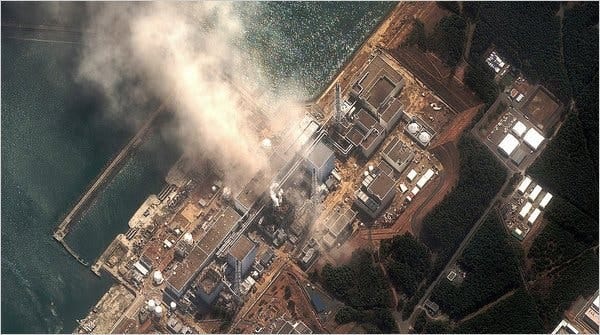
It’s the 15th anniversary of the Fukushima nuclear disaster, and any lessons from that event seem to have been forgotten by most. Political leaders of all stripes, from centre-left to far right have been keen to promote nuclear power as at least a partial solution to the problem of replacing coal and gas. The peak of enthusiasm was reached at COP 28 when Joe Biden, Emmanuel Macron and Rishi Sunak signed a pledge to triple nuclear power generation by 2050.
To call this pledge ambitious would be an understatement. No nuclear plant has started in construction (as defined by first nuclear concrete) in Europe or North America since the disastrous Hinkley C project in 2017. And the future is not much better. The UK will presumably go ahead with the Sizewell C project, duplicating Hinkley, but that will only replace retirements of existing plants. In France, sites for six reactors have been identified, but no investment decision has been made. And in the US, even the announced restart of reactors closed as uneconomic in recent years is looking doubtful.
Actually existing nuclear power programs around the world are similarly limited. China has an established industry which starts construction around 10 new plants every year, and typically connects them 5 to 6 years later. Russia builds about one per year, mainly to replace old RMBK (Chernobyl style) plants.
Russia’s nuclear firm Rosatom also has an export business. The typical pattern is a generously financed project, building two to four reactors in a middle-income country that wants the prestige of having nuclear power. South Korea has completed one such project (Barakah in UAE, which took about 15 years) and has a contract for another with the Czech Republic. Because nuclear power is uneconomic even with subsidies, these deals are typically “one and done”. Having shown that they can generate nuclear power, few countries have been willing to strain their budgets for a second vanity project.
The great remaining hope is Small Modular Reactors (SMRs).
This term is commonly used to refer to reactors small enough to be built in a factory and modular in the sense that they can be shipped to a site in the numbers required to meet the power needs of the installation. It is also used more loosely to refer to reactors generating less then 500 MW of electricity, compared to the 1000-1400 MW that have been standard in recent decades.
SMRs of the first kind don’t exist and probably never will. All the early proponents, with one exception have given up. The only surviving firm, Nuscale, had to abandon its initial plan to construct plants in the US because of cost over-runs. A contract has supposedly been signed with Romania, but the Romanian PM sounded distinctly unenthusiastic in a recent interview.
“As I remember it is a fairly big sum, USD6-USD$7 billion and the business plan must also account for how the energy will be consumed. The investment will be made once a funding formula will be found. Given the very large amount of money, the complexity of such projects and the technology being in early days, I estimate we will not see the investment immediately.”
For reference, given a capacity of 462 MW (6 units of 77MW), the implied unit cost is $US13-15 billion per GW or $A20-23 billion. This is well above the much-criticised CSIRO GenCost estimates.
There are quite a few small but non-modular reactors around. Unfortunately most of these are relics from the early days of nuclear power (Gen II in the jargon). There are only two recent prototypes, one in China and one in Russia. Quite a few others have been announced, but they have no real advantage over the larger designs from which they are derived. Even if a handful get built, they are irrelevant to the future of energy.
In summary, nuclear power is a technology of the past. The only routes to a clean energy system are renewables and energy efficiency.